
Headless Commerce
Cadenic Studios connects Shopify to a storefront built entirely to your design, so merchandising stays where your team already works while the buying experience stops looking like a theme.
A storefront that is yours down to the pixel, with the catalogue, the checkout and the money still handled by systems your team already trusts. The same discipline applies to revenue that never touches your own cart.
What it gets hired to build
6 kinds of project
- Custom storefronts on an existing Shopify catalogue
- Brand and merchandise shops for a product or creator
- Product configurators and made-to-order flows
- Subscription and membership commerce
- Digital goods and licence delivery
- Migration off a theme without losing the catalogue
That list shows the shape of the work. It is neither complete nor a menu of packages. If what you are building is not on it, the question is whether it is the same kind of problem, and that is a short conversation.
A headless build separates the catalogue from the shopfront. Your team keeps working in the Shopify admin they know; the customer sees a storefront designed and rendered by us, at the speed of a static site, on a domain and a codebase you own. We wire the Storefront API, the cart, the hand-off to Shopify's own checkout so payments stay their problem, the transactional mail, and the analytics that tells you which merchandising decision worked. Where a catalogue is small or a product is digital, we will say so and build the simpler thing.
What you get
- 01Shopify Storefront API integration over GraphQL
- 02Custom product, collection and cart experience
- 03Secure checkout hand-off and order confirmation flow
- 04Transactional email and audience capture
- 05Merchandising and conversion instrumentation
Stack
- Shopify Storefront API
- GraphQL
- Next.js
- Resend
- Vercel
Proof
Two pieces of work for this service, both live and both ours. Either one opens in a click.
Evidence 01
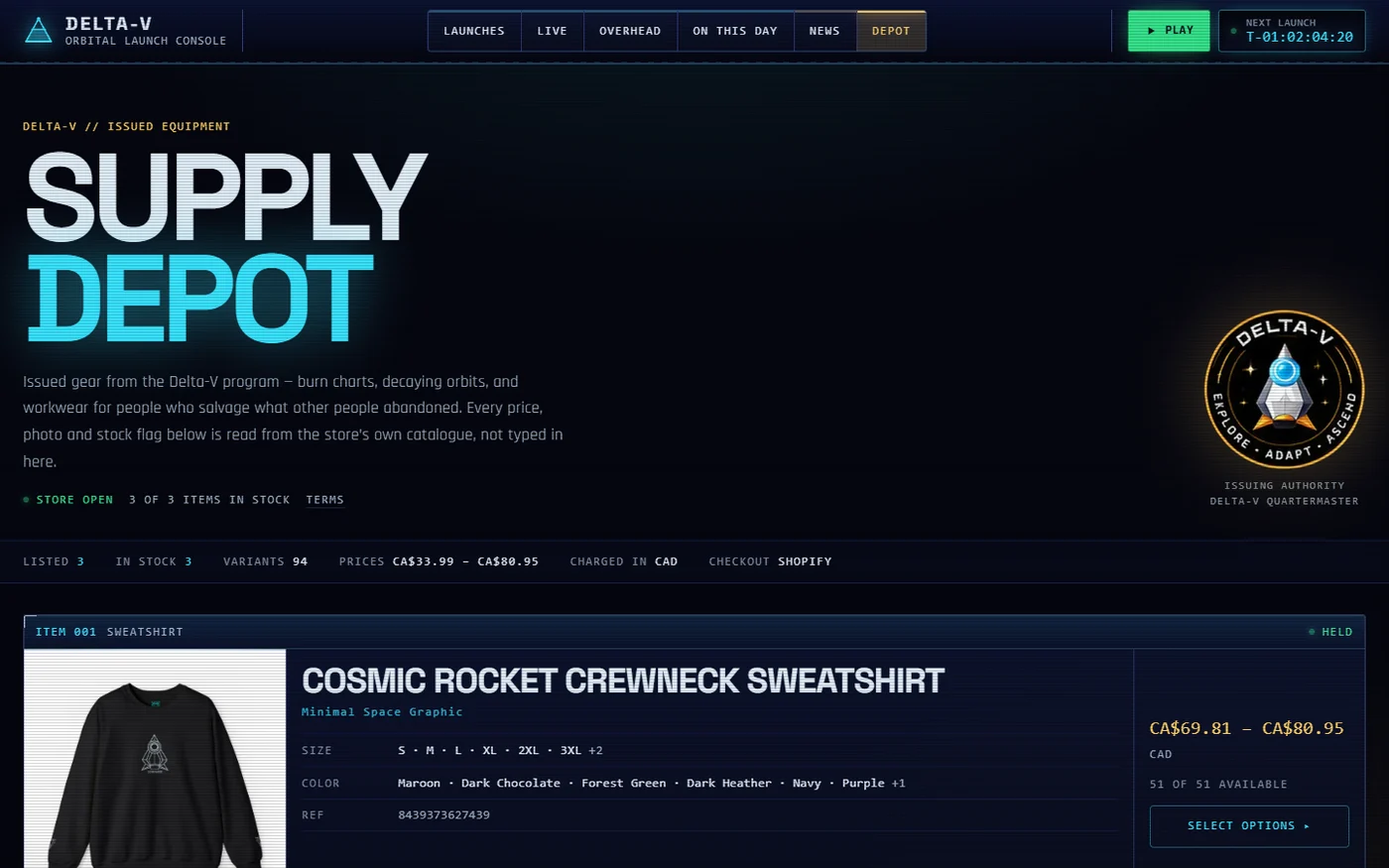
The Delta-V supply depot runs headlessly against the Shopify Storefront API inside playdeltav.space. It queries products and variants, holds the cart, and hands off to Shopify's own checkout, so merchandising stays where a merchant expects it while the storefront is entirely ours. The depot sits inside the studio's heaviest data build: twenty-eight routes, almost none of them static, each readout with its own stated freshness budget.
- routes, almost none of them static
- 28
- days of almanac, cross-linked
- 366
- launch vehicles on the register
- 60
- Storefront API over GraphQL: Shopify keeps the catalogue and the checkout, we keep the experience
- Transactional email through Resend, with dynamic social cards and calendar files on the same site
- Cache lifetimes set readout by readout rather than once for the whole site
Evidence 02

getscorebug.app earns two ways. Amazon Associates, Impact and AvantLink run across a hundred and fifty-four generated club gear pages, with the disclosure printed on each of them, and a headless Shopify shop sits alongside. Revenue that funds the product without becoming the product.
234 pages from 15 route files · 154 club pages, generated
- 154 club storefronts, generated from one route over a typed dataset
- Affiliate disclosure printed on the page that carries the link
- Headless Shopify alongside the affiliate catalogue, on the same site
Where it stopsThe Delta-V depot is open: real products, ninety-four variants, live stock flags, prices in Canadian dollars, and a checkout handed to Shopify so payments stay their problem. The affiliate side of getscorebug.app is live alongside it. Both are ours end to end. We built the storefront; the payment rails are theirs.
See the Delta-V depotThe rest of the practice
Three more, same discipline
Cadenic Studios runs five services and they are the same practice pointed at different surfaces. Most projects touch more than one.
- 01Web & Application DevelopmentSoftware with accounts, roles and real data, and an admin surface your own team can run.
- 02Growth & Revenue EngineeringPages that go and find the audience, generated from your own data and measured.
- 03Native App DevelopmentGet the app into the store, with the billing and the release process handled.
- 05Discord & Community EngineeringA server built from a script, a bot that answers from your live data, and an address you own.
Method
How a project runs
The same five steps for every service. Nothing is committed to a build until the scope is written down and agreed. The studio page sets all five out in full, with what each one produces.
- 01Brief
- 02Call
- 03Scope
- 04Build
- 05Handover
Start a project
Tell us what you are building
Send the scope, the timeline and a budget range. Wyatt McPherson replies to every enquiry in writing. A short call, then a scoped estimate.